

By two in the afternoon most days, my lower back has already made its opinion known. Twelve years running a landscaping crew in Chattanooga does that. Ladders in the morning, mower vibration through the afternoon, forty pound mulch bags in between, then another stretch behind the wheel driving to the next job. I'm not a desk worker, so when I first heard about a heated massage seat cushion I figured it was built for somebody sitting at a computer, not somebody climbing in and out of a work truck forty times a shift. I was wrong about that, and this is the routine I actually run now with a Snailax cushion in my F-250 and on the couch at home, not in an office anywhere.
This isn't a review. I've already written the long version of that, five months in a truck seat, in my long-term Snailax review, and the parts I left out the first time in my honest Snailax review. This is the actual how-to, the five steps I'd tell Odell if he asked me exactly what to do the day his own cushion showed up, which he did, since he ordered one after borrowing mine for a week and getting tired of waiting for me to explain it in person.
Your Lower Back Doesn't Clock Out When You Do
If you spend real hours in a work truck seat or any chair and your lower back files a complaint by Thursday, here's the exact setup that's kept a heated massage cushion strapped into my truck for a full season.
Amazon Check Today's Price on Amazon →Step 1: Figure Out When Your Back Actually Locks Up
Before you strap anything into a seat, spend two or three days just noticing your own pattern. Mine is specific. My lower back is stiffest in the first fifteen minutes of sitting after a cold, damp valley morning, and again by mid afternoon after a few hours of ladder work and mower vibration. It isn't constant, and it isn't the same all day, which matters because it tells you when a heated massage seat cushion is actually worth turning on, not just leaving running out of habit. Write it down if you have to, morning, midday, or evening, because guessing wastes the first week of a routine you're trying to build.
If your worst stiffness hits first thing in a cold seat, you want heat working early. If it's an end-of-day buildup from hours on your feet, you want the vibration timed to your drive home instead. I run both, because my mornings and afternoons are different problems, but figuring out which one is actually yours saves you from turning the cushion on and off at random and wondering why it doesn't seem consistent. Odell's pattern is different from mine entirely, his flares up in his shoulders on cold mornings and his lower back doesn't bother him until much later, so don't assume my schedule is your schedule.
Step 2: Get the Cushion Strapped Into the Seat You Actually Use
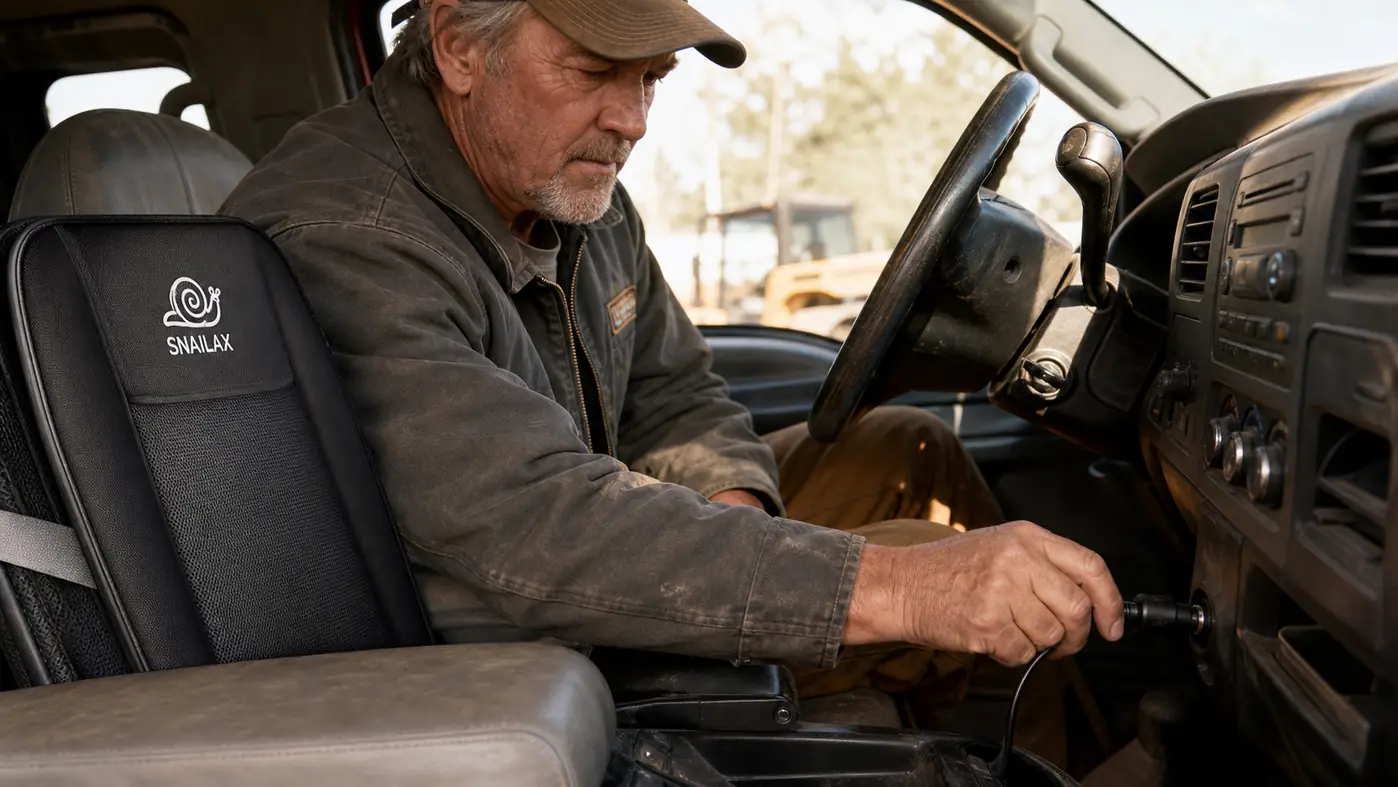
This step took me longer than I expected the first time, and I'll say it plainly so you don't feel like you're doing it wrong. My F-250's bucket seat has a fixed headrest set at an angle, not a straight-up-and-down post like a standard office chair, and the top strap on the Snailax cushion is sized for that standard shape. Getting it to sit flush instead of riding up toward my neck took looping the strap through itself and about fifteen minutes of fussing the first time. If your seat is anything other than a plain desk chair, budget that same patience, and don't judge the whole product on a rough first ten minutes.
Once it's set, it stays set. The lower strap needs to cinch tight enough around the seat back that the cushion doesn't slide down every time you climb in and out, which on a work truck is a lot of times a day. I fit mine to the truck seat permanently and keep the couch as the second stop, unbuckling it two or three nights a week and carrying it inside with the same cushion rather than owning two. That's the setup that's actually held up. Trying to fit and refit it to a desk chair on top of a truck seat and a couch is more work than the relief is worth, and it's the fastest way to talk yourself out of using it at all.
Plan your cord routing at the same time as the straps, not after. The Snailax cushion ships with a car adapter for the 12-volt outlet and a separate wall adapter for a standard household plug, and if you're swapping the cushion between a truck and a couch the way I do, you'll want both cords staged where you can reach them without digging through a console or a junk drawer. I keep the wall adapter looped over a hook by the couch and the car adapter clipped to the passenger seat pocket, so moving the cushion inside at night takes thirty seconds instead of turning into a search.
Step 3: Start Low on Heat and Vibration Before You Dial It Up
The Snailax cushion runs six motors, four along the spine and two under the seat panel, and two heat levels. The instinct the first week is to crank both to the top setting because you paid for the feature, but that's not where I've landed after months of actual use. On the lower intensity settings, the vibration is enough to work the two lumbar motors, the ones doing the real job on my lower back, without the noise the higher settings put out, which my wife Renata has commented on more than once from across the room. Starting too strong on day one is also how a lot of people quit early, because it feels like too much rather than like relief.
Heat works the same way. On high, it's noticeably warm within a few minutes, but I only run it there for the first ten minutes of a cold drive before dialing back, mostly because by then it's already loosened things up. Running everything on the top setting all the time doesn't actually speed up relief, it just runs the motors louder and warms you up faster than your body needs. Start low, notice what your lower back actually responds to, and only move up if low genuinely isn't cutting it. Give each setting at least three or four uses before deciding it isn't strong enough, because the first try in a cold truck cab feels different than the fifth.

Step 4: Time the Heat to Your First Drive and the Vibration to Your Worst Hour
My routine now is built around two windows. In the morning, the cushion is plugged into the truck's 12-volt outlet the second I start the engine, so the heat is already working during the fifteen to twenty-five minute drive to the first job, before my lower back has to deal with a ladder. That's the window where heat matters most for me, since a cold, stiff back doing ladder work is asking for trouble, and I've learned the hard way that skipping this window on a busy morning means fighting stiffness on the ladder instead of in the truck.
The second window is evening, on the couch, with the wall adapter swapped in for the same cushion. Two or three nights a week, boots off, I sit with it running on low vibration while I ice my knee and Renata catches me up on her shift at the hospital. That's the window aimed at the buildup from the whole day, not just the morning stiffness. Splitting the two windows like this, rather than just leaving the cushion running randomly whenever I remember it exists, is the single biggest change that made this actually work for me instead of feeling like a novelty that eventually ends up in the garage.
One habit that goes with the morning window: don't leave the cushion plugged into the 12-volt outlet with the engine off. I keep half an eye on that myself, since I've had truck accessories drain a battery before, and there's no reason to risk it for a cushion that only needs to run while you're actually driving anyway. It's a small discipline, unplug it once you're parked at the job site, but it's the kind of thing that keeps a good routine from turning into a dead battery on a Monday morning.
Step 5: Track It for Two to Three Weeks Before You Decide Anything
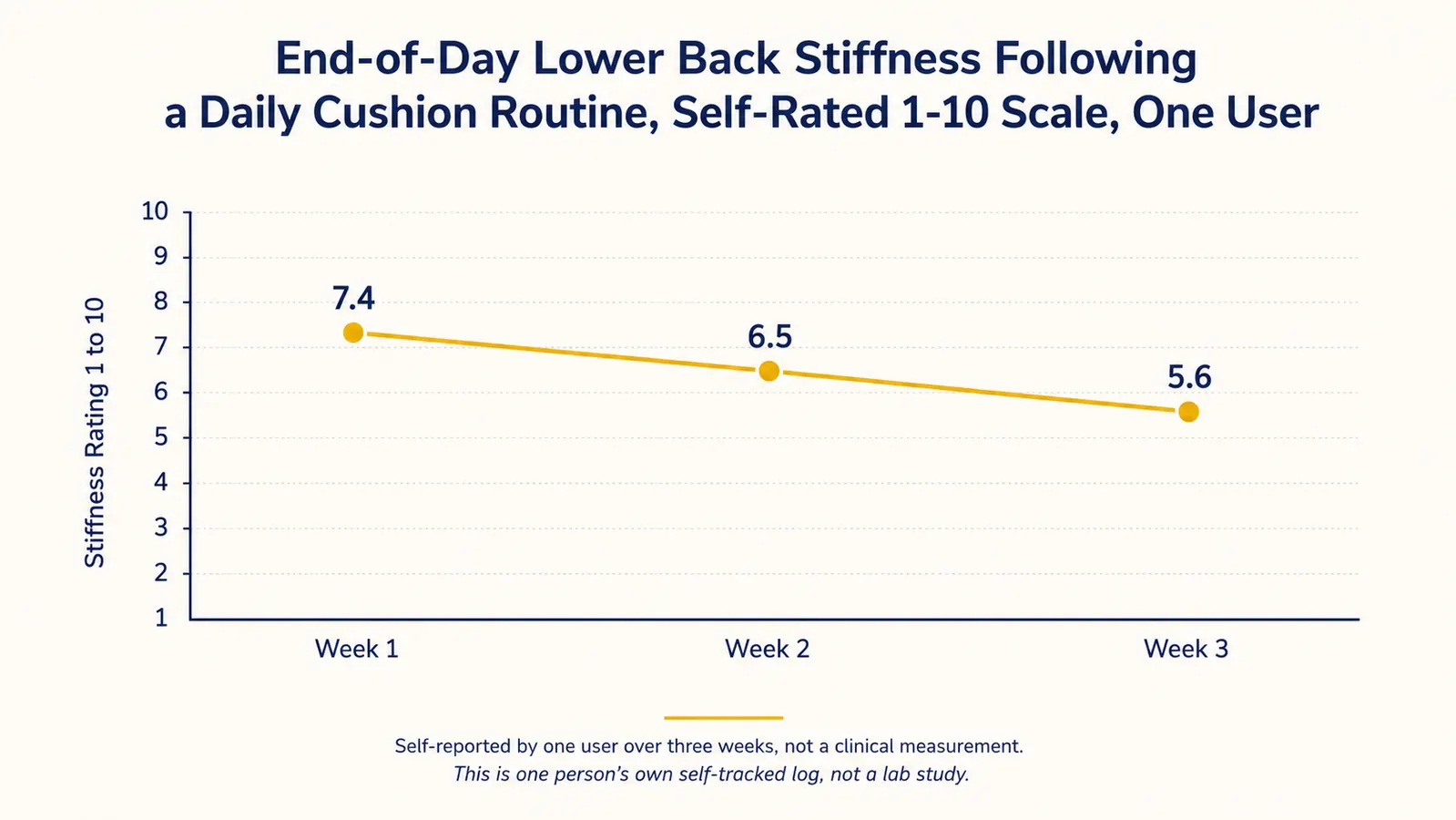
Week one felt almost too good, the kind of relief where you tell every guy on the crew about your new seat cushion, which I did, and which Odell still brings up. That first-week enthusiasm isn't the real signal though. What told me the Snailax cushion was actually doing something was noticing the difference on days I skipped it, borrowing the crew truck instead of my own, versus the days I used it. Give it two to three weeks and rate your own end-of-day stiffness on a simple scale, even just a note in your phone, before deciding whether it's earning its spot in your truck or your living room.
One practical thing worth knowing going in: the vibration function shuts off automatically after twenty minutes, which caught me off guard the first few times I climbed back into the truck after walking a job site and found it had gone quiet. Build re-pressing the button into your routine rather than assuming it'll keep running the whole drive, or you'll end up finishing the last leg without it and wondering why the relief tapered off. Small habits like that are the difference between a cushion that actually gets used every day and one that quietly stops earning its keep.
What Else Helps
A heated massage seat cushion isn't the whole answer, and I'd be lying if I said it was. I still stretch most mornings before the first job, and a lacrosse ball on the garage floor still handles knots the cushion's fixed motors can't quite reach for my particular build. None of that is free time I have extra of, but it's cheap and it stacks with the cushion rather than replacing it. If you want the fuller case for why heat and vibration specifically help on top of stretching, I laid out the reasoning in 10 Reasons a Heated Massage Cushion Eases Back Pain After a Long Day, and if you're deciding between the Snailax cushion and another option entirely, I put together a straight comparison in Snailax vs Comfier: Heated Massage Seat Cushions Compared. And if this is more than ordinary end-of-day stiffness, if it's a real diagnosed issue, that's a conversation for a physical therapist, not a seat cushion routine. My own PT, Dana, is who I'd send you to before any gadget, and Dana would tell you the same thing I'm telling you here, a cushion supports a routine, it doesn't replace one.
It didn't fix a decade of ladders and mower vibration. Nothing plugged into a cigarette lighter is going to do that. It just gave me a routine that made the drive home, and the six o'clock version of me, a lot less miserable.
Five Steps, One Truck Seat, A Full Season Later
This is the exact routine that's kept a heated massage cushion strapped into my F-250 since spring, not a one-time gimmick. If your lower back is filing the same complaint mine used to, it's worth building this into your own day.
Amazon See the Snailax Massage Seat Cushion on Amazon →