

I've got three half-used rolls of KT Tape sitting in my truck's center console right now, and if you'd asked me two years ago whether a roll of stretchy tape would ever earn a permanent spot in a work truck, I'd have laughed you out of the driveway. My name's Wes Coburn, I run a landscaping crew out of Chattanooga, and my right knee has opinions about ladders that it did not have at thirty. This isn't the long version of my KT Tape story, that one's over at the three months I spent taping every morning before work. This is the honest version, the stuff that doesn't make it into the glossy Amazon listing photos: the peeling, the itch, the fifteen minutes I lost the first time I tried to tape my own shoulder in a gas station bathroom mirror.
Here's what nobody selling KT Tape tells you up front. It is not magic. It will not fix a knee that actually needs a doctor's attention, and I say that as a guy who has genuinely gotten a lot of use out of it. What it does is support a joint that's tired, not broken, through a long day of hauling mulch and climbing extension ladders. That distinction matters more than any ad copy KT Tape prints on the box.
I bought my first box off Amazon on a whim, the 20 count precut strip pack, because I didn't want to deal with cutting my own lengths off a full roll with a work truck steering wheel in one hand. Twenty strips sounded like plenty. It lasted me about eleven days once I started actually taping daily, which tells you something about how often a working knee actually needs support versus how often the marketing photos make it look optional.
The Quick Verdict
Genuinely useful for a tired joint on a long workday, but expect real peeling in sweat and rain, and budget ten failed strips before your technique clicks.
Amazon Check Today's Price →Still Wondering If Tape Actually Holds Up on a 9-Hour Workday?
I run the same roll through concrete, ladders, and a hose-down at the end of the day. Here's the KT Tape 20-count pack I keep restocking. Check today's price and reviews on Amazon.
Amazon See Today's Price on Amazon →How I've Actually Used It
I didn't set out to review KT Tape for anybody. Odell, my training partner, tried it first after his physical therapist mentioned kinesiology taping for his shoulder, and I stole a strip off his roll of KT Tape out of curiosity on a Tuesday in March. That first strip lasted through one job, a fence install with a lot of post-hole digging, before the corner started curling off my knee by four in the afternoon. I almost wrote the whole thing off right there.
What kept me trying was that the knee felt different with it on, even with a peeling corner. Not fixed, just steadier going up and down the ladder. So I bought my own box of KT Tape and started paying attention to what actually made a strip last versus what made it a wasted six inches of tape.
Since then I've gone through more full rolls than I want to admit, mostly on my knee and lower back, occasionally on a shoulder when the mornings turn cold and damp in the valley. I've also handed strips to my son Trey when he tweaked something moving a mower, so this isn't just a one-knee sample size.
By late spring I'd moved past the knee and started taping my lower back on Thursdays, which is the day the stiffness always catches up with me no matter how many mornings I've lifted that week. It's not as dramatic a difference as the knee, my back still gets tight by quitting time, but the tape seems to remind me to keep better posture climbing in and out of the truck bed, which might be half the actual benefit.
The Peeling Problem Nobody Warns You About
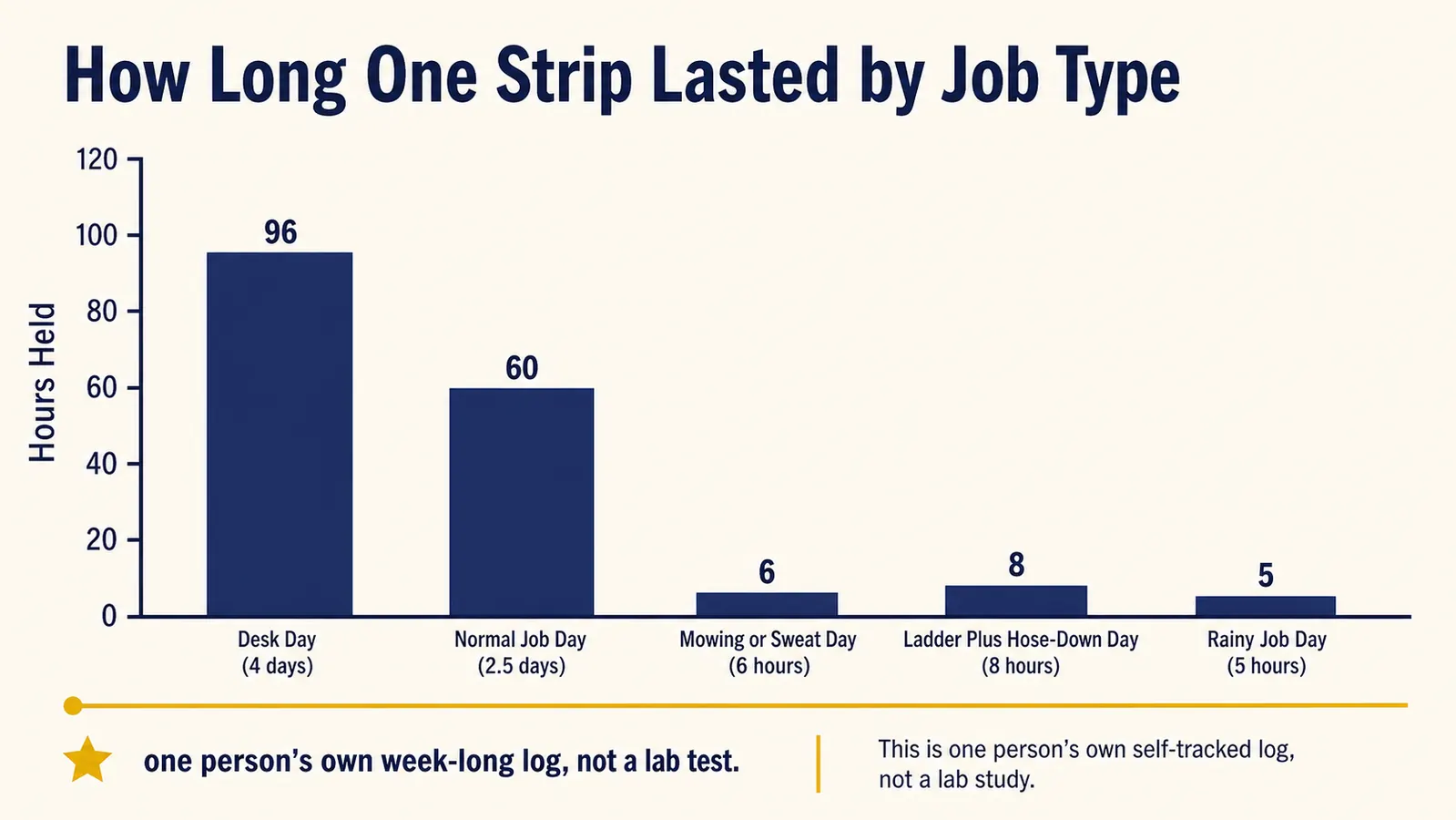
This is the complaint I see buried in the one and two star Amazon reviews, and it's real. KT Tape's edges lift in heat and sweat faster than the packaging suggests. On a normal desk-type day it might hold close to four days like the brand claims. On a mowing day in July, with sweat soaking through by ten in the morning, I'm lucky to get through lunch before a corner starts curling.
The fix, and this took me embarrassingly long to figure out, is rounding the corners of every strip with scissors before you apply it, and rubbing the tape hard for a solid thirty seconds after you stick it down. That friction is what actually activates the adhesive. Skip that step and you're basically wearing a sticker, not a piece of kinesiology tape.
Rain and hose-downs are the real test. If I know I'm hosing off equipment at the end of the day, I'll press the edges down again right before, as insurance. It's a workaround, not a fix, and KT Tape doesn't mention it anywhere on the box.
I tried switching to the synthetic version at one point during a stretch of especially sweaty weeks, hoping it would hold better than the cotton weave. It held marginally longer in heavy sweat, maybe an extra hour or two, but it felt stiffer against the skin and I went back to the cotton strips within a month. If you're deciding between materials, don't expect the synthetic option to solve the sweat problem, it just delays it slightly.
The Application Learning Curve Is Steeper Than the Videos Suggest
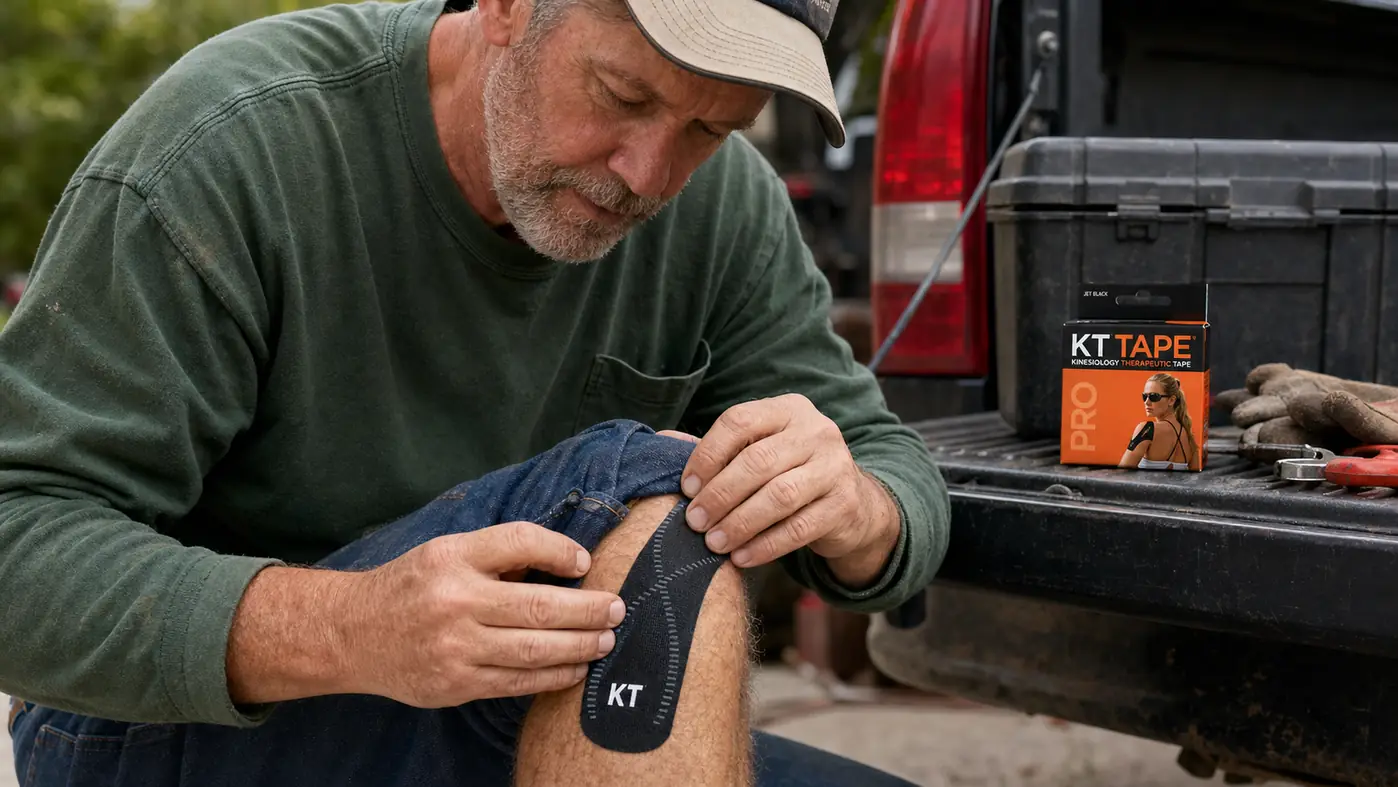
Every demo video makes taping your own knee or shoulder look like a thirty second job. My first ten attempts were nowhere close. Taping your own shoulder, in particular, is close to impossible to do correctly alone without a second set of hands or a very patient wife willing to help before her shift at the hospital.
Renata helped me with my shoulder strips for the first month before I got good enough to do a rough version myself using a mirror and a lot of patience. If you're planning to use KT Tape on your back or shoulder and you live alone, budget for a learning curve measured in wasted strips, not minutes. I've got a full walkthrough on taping shin splints step by step if you're taping somewhere easier to reach.
The other thing that took me too long to learn is that how much you stretch the tape before sticking it down changes everything. Too much stretch and it feels like a rubber band pulling your skin the wrong way by afternoon. Too little and it might as well not be on there. KT Tape's own instructions call for roughly fifty percent stretch through the middle of the strip and no stretch at all on the anchor ends, and once I actually followed that instead of eyeballing it, my strips held better and irritated my skin less.
Knees and ankles are far more forgiving. I had those down inside a week. It's the back and shoulder placements where the learning curve actually bites.
Skin Irritation, and What Actually Helped
After about six weeks of near daily wear, I started getting a mild red rash where the adhesive sat longest, right along the inside of my knee. Nothing that needed a doctor, just annoying, itchy skin that made me want to rip the tape off early some afternoons.
Rotating placement by an inch or two each time and giving my skin a full day off every week or so cleared it right up. I'm not a dermatologist, and if you've got sensitive skin or a known adhesive allergy, this is worth testing on a small patch first rather than wrapping a full knee and finding out the hard way like I did.
I also learned that showering the night before instead of the morning of made a real difference. Applying tape to skin with leftover sunscreen, bug spray, or the grime from yesterday's job seemed to make the adhesive grab unevenly and irritate faster. A clean, dry, oil-free patch of skin the morning I apply it has cut down on both the peeling and the rash considerably.
KT Tape does sell a version marketed for sensitive skin, though I haven't tested it myself since the standard cotton strips eventually stopped bothering me once I started rotating placement and giving my knee a break every so often.
Is It Actually Better Than Regular Athletic Tape, or Just Better Marketing?
This is the question that got me testing in the first place. Regular white athletic tape is stiffer, doesn't stretch, and restricts motion almost entirely, which is exactly what you want for a sprained ankle the day it happens. KT Tape is built to move with the joint, not lock it down, which is a different job entirely.
For my knee on a ladder day, that stretch matters. I need to bend it going up and down all day, not immobilize it. For an actual acute injury, athletic tape or a real brace is the better tool, and I'd tell anyone reading this the same thing. KT Tape is for managing a tired joint, not for emergencies.
There's also a durability angle nobody selling either product wants to bring up. A roll of stiff athletic tape is basically single use, you cut it off at the end of the day and it's garbage. A well applied strip of KT Tape can sometimes survive a full shower and go another day if you're gentle with it, which changes the math on how many strips you actually go through in a month.
If you're trying to decide between kinesiology tape and something stiffer like RockTape, I broke down the actual differences in a side by side comparison rather than repeating that ground here.
Where It Genuinely Earned Its Spot
For all the griping above, I keep buying it, and that has to count for something. On a normal ten hour landscaping day, KT Tape gives my knee enough support that I notice the difference by hour six, when I'd normally be favoring it going up the ladder.
It's also affordable enough per strip that I don't think twice about cutting off a bad application and starting over, which matters when you're still learning technique. And unlike a brace, it doesn't add bulk under a pair of work pants, which matters more than people expect when you're moving all day.
There's also the fact that it's discreet. Nobody on a job site asks a landscaper wearing a knee brace how his knee's doing all day, every single day, like they've appointed themselves my physical therapist. A strip of tape under a pant leg draws exactly zero questions, which sounds small until you've had the brace conversation for the fortieth time.
What I Liked
- Genuinely helps a tired joint feel more supported through a long physical workday
- Stretches with the joint instead of locking it down like stiffer athletic tape
- Doesn't add bulk under work pants or long sleeves
- Affordable enough per strip to reapply without hesitation while you're learning technique
- Odell and my son Trey both got real use out of it independently, so it isn't just me
Where It Falls Short
- Edges peel fast in heat, sweat, or a hose-down, faster than the packaging implies
- Taping your own shoulder or back alone is genuinely difficult without help
- Mild skin irritation showed up after about six weeks of near daily wear
- Not a substitute for a real brace or medical care on an acute injury
- The application learning curve is longer than the demo videos make it look
It doesn't fix a knee. It just makes a tired one feel steadier for the last three hours of a nine hour day, and some days that's the whole ballgame.
Who This Is For
If you're on your feet for a living, or you train hard around a full time job, KT Tape earns its keep. It's for the guy climbing ladders all day, the weekend athlete managing an old injury, anybody who needs support that moves with them instead of against them. If you're curious what else people claim it does for recovery, I laid out ten specific ways it's supposed to help, though I'd bring the same skepticism to that list as I've brought to this one.
It's also for anybody who's tried a heavier brace or sleeve and found it too hot or too restrictive for actual physical work. KT Tape breathes better than neoprene ever will, which matters a lot more in a Tennessee summer than it does in a climate controlled gym.
Who Should Skip It
Skip it if you've got an actual acute injury that needs a doctor, a brace, or real athletic tape, not a stretchy strip. Skip it if you've got known adhesive sensitivities and aren't willing to patch test first. And skip it if you're not willing to spend a couple weeks getting the application technique right, because a badly applied strip is just an expensive sticker. I wrote up the exact day my knee finally forced the issue over in my ladder days story, if you want the version with more grumbling in it.
And skip it if what you're really looking for is something that requires zero maintenance. Every strip eventually peels, itches, or needs replacing, and if that kind of upkeep sounds like a hassle rather than a minor annoyance, a brace or sleeve might genuinely serve you better long term.
Ready to See If It Holds Up on Your Own Workday?
Twenty precut strips, enough to figure out your own technique without running out halfway through. Check today's price and current reviews on Amazon.
Amazon Check Today's Price on Amazon →