
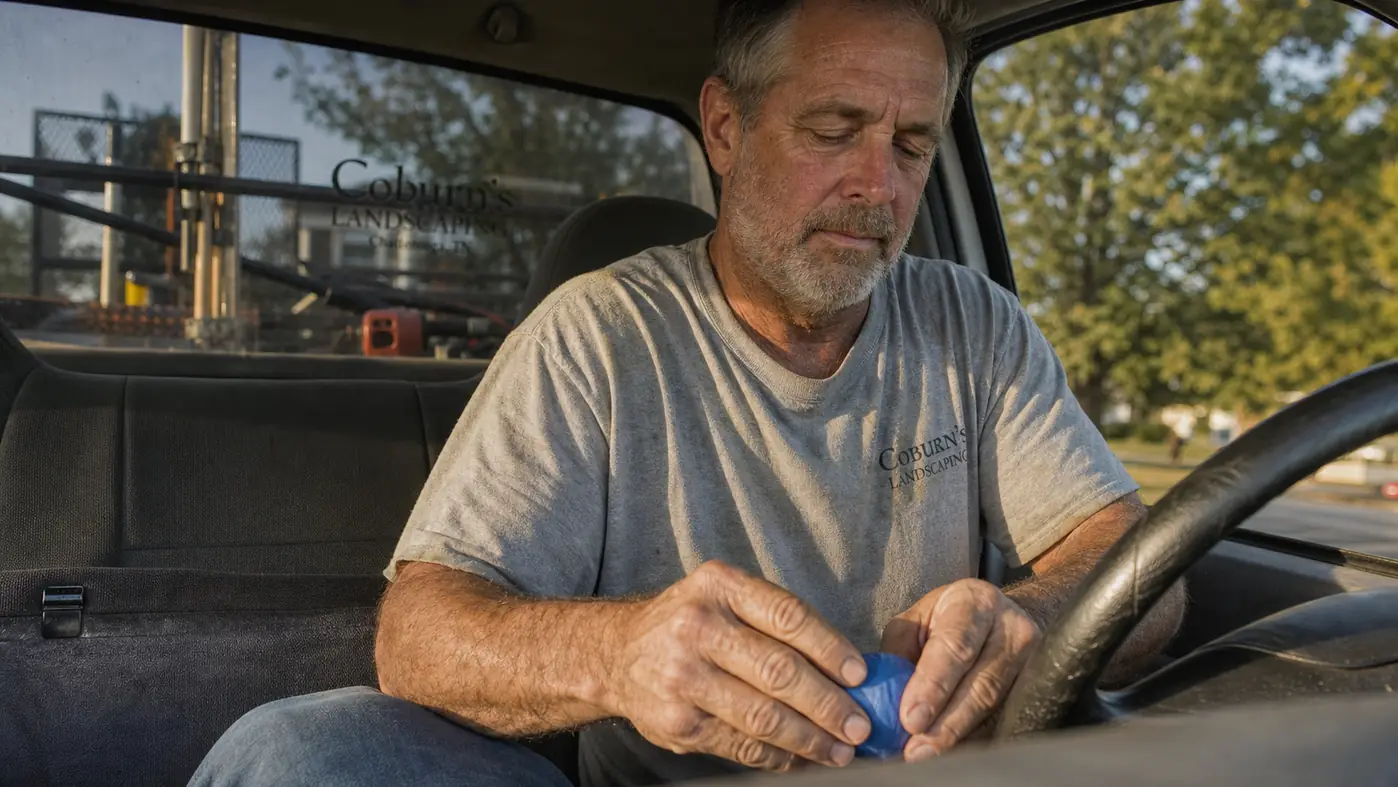
I tore something in my right forearm the third week of April, wrestling a root ball out of a client's flower bed with a mattock. It wasn't dramatic. No ER trip, no sling. But six weeks later my grip was still garbage. I couldn't twist a hose bib without wincing, and shaking a client's hand at the end of a job felt like an apology. My physical therapist, over at the sports med place on Hixson Pike, put four tubs of colored putty in my hand before I even left that first visit. Yellow, red, green, black. That's FlintRehab Therapy Putty, the 4-pack, and four months later it's still riding around on the console of my work truck.
I'm 56, I run a landscaping crew, and I blew out my throwing shoulder playing college ball at 21, so I've been managing joints and tendons for longer than I care to admit. What I have not done much of in 35 years is dedicated hand and forearm work. This review is about what happened when I finally did, and about the parts that were more annoying than I expected.
The Quick Verdict
Simple, boring, and it worked. Four resistance levels got me from a weak, guarded grip back to full strength in about three months, no gym required.
Amazon Check Today's Price →The forearm ache from gripping tools all day isn't going away on its own. This is the boring fix that actually worked.
FlintRehab's 4-pack gives you four resistance levels in one order, so you're not guessing which putty to buy or restocking every few weeks. Check today's price and current availability on Amazon.
Amazon Check Today's Price on Amazon →How I've Used It
There's no ceremony to this. I keep the yellow and red tubs in the truck's center console, and the green and black ones on the kitchen counter at home. Between job sites, while I'm waiting on Odell to finish loading the trailer or while I'm eating a sandwich at lunch, I'll work a tub for five or six minutes. Squeeze, hold, release. Finger extensions where you push your fingers out against the putty instead of curling into it. Pinch work between thumb and each finger, one at a time. None of it requires quiet or a mat or forty-five minutes I don't have.
The other block is after dinner, boots off, on the couch. Renata, my wife, is a nurse and she's skeptical of every gadget I bring home, but even she admitted this one made sense. Unlike a foam roller or a massage gun, there's no motor, no charging cable, nothing to break. It's a ball of putty in a tub. She'll tell you that's exactly why it's stuck around when other things I've bought have ended up in a drawer.
Odell, my training partner, tried it too after I wouldn't shut up about it for a month. He's 61 and deals with early arthritis in his hands from decades of framing work before he semi-retired into landscaping with me. He uses the red and green tubs mostly for the pinch exercises, since that's where his stiffness shows up first thing in the morning, before either of us has had coffee.
Weekends are different. No job sites, no truck console. I keep a tub on the back porch and do a couple sets while I'm watching Trey's kid try to figure out the tire swing, or while Jolene's on speakerphone telling me about her week. It's turned into one of those habits that doesn't feel like a chore because it fits into whatever else is already happening, which is the only kind of recovery routine that ever survives contact with my actual schedule.
The Four Resistance Levels, and Why That Matters More Than I Expected
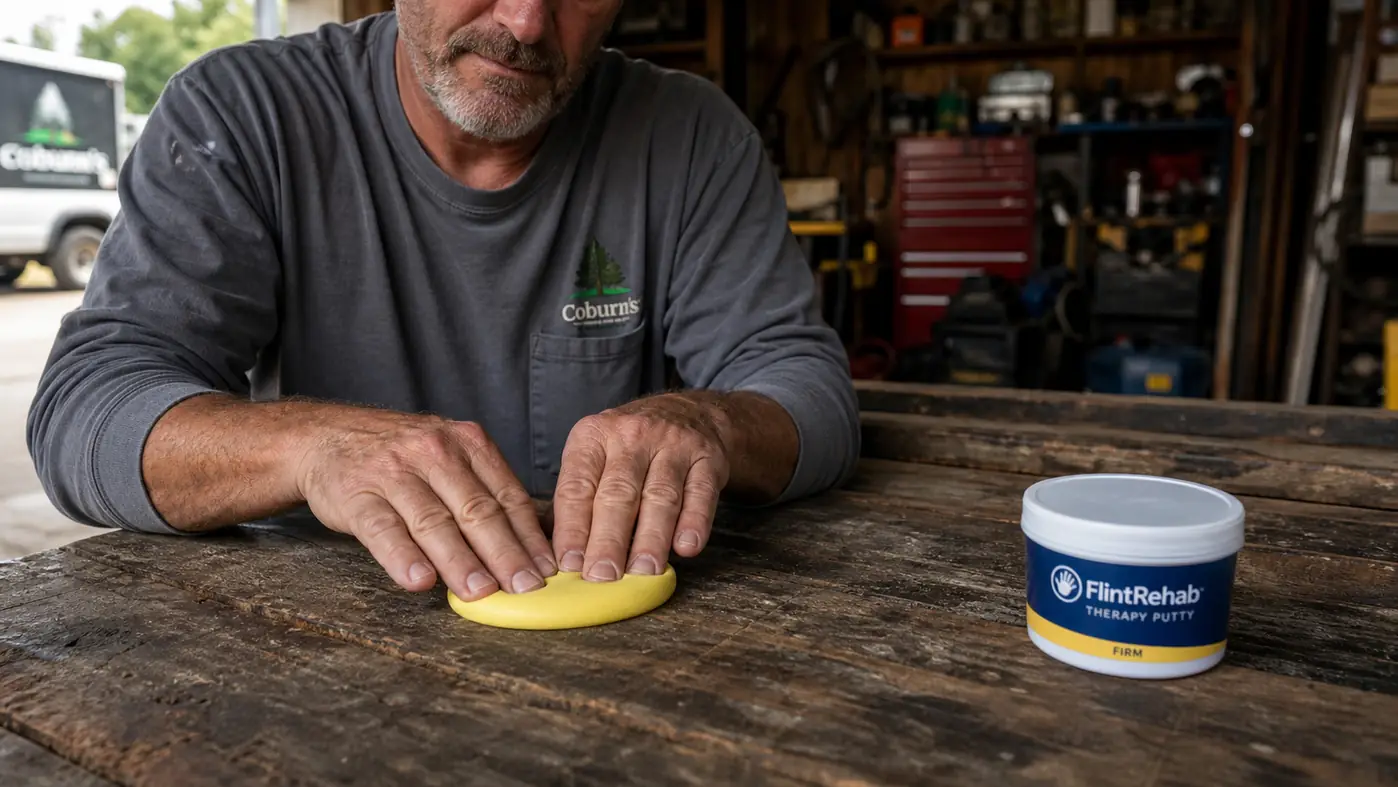
I didn't think much of the four-tub setup when Dana handed it to me. I figured I'd use whichever one felt fine and move on. What actually happened is the progression became the whole point. Week one, the yellow putty, the softest of the four, was legitimately hard for me to close my fist around fully on the injured side. That told me something the mirror never would have, that my grip had quietly gotten weaker than I realized while I was babying the forearm.
By week five or six I'd graduated to red without thinking about it, because yellow had turned into something I could squeeze one-handed while driving with my other hand on the wheel, which isn't advice, just what actually happens on a job site. Green came around week nine. FlintRehab labels the four levels x-soft, soft, medium, and firm, and the jump in resistance between each one is honestly bigger than I expected from looking at four identical-looking tubs of putty.
I'm still working into the black tub, the firmest one, four months in. That's on purpose. Dana told me not to rush it, that the point of therapy putty isn't to blast through all four colors as fast as possible, it's to only move up once the current one stops giving you any real resistance at the end of a set. I ignored that advice exactly once, jumped to green too early, and my forearm let me know about it the next morning.
The texture changes between tubs too, not just the resistance. Yellow feels almost like warm gum, soft and slightly tacky. Black is dense enough that on a cold morning it takes a minute of working it in my hands before it stops feeling stiff and brittle, closer to cold caulk than putty. I've learned to let it warm up in a pocket for a few minutes before a hard set, especially once fall temperatures show up in the valley.
What Four Months of Daily Squeezing Actually Changed
I'm not going to pretend this fixed a torn muscle by itself. I saw Dana for six weeks of actual physical therapy, and the putty was homework, not treatment. But the homework is what carried past the point where insurance stopped paying for visits.
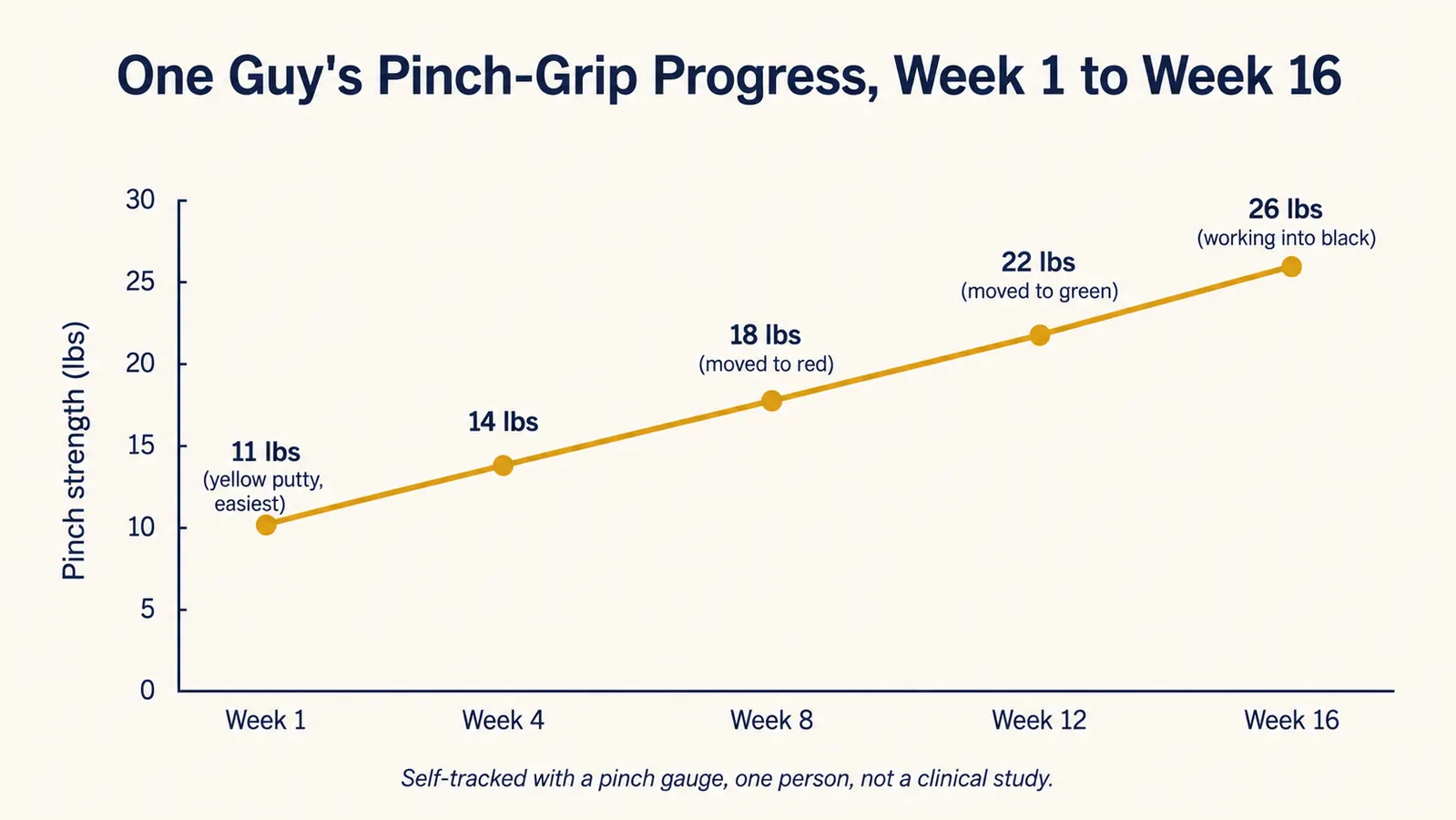
What I can tell you honestly, because I tracked it with a cheap pinch gauge Dana loaned me, is that my pinch grip on the injured hand went from about 11 pounds in week one to around 26 pounds by week sixteen. That's one guy, self-measured, not a lab study, and your mileage depends entirely on where you're starting from and what you're recovering from. But it's a real number I wrote down on a legal pad in my truck, and it lines up with what I felt on the job: I can grip a shovel handle or a pair of loppers all day again without that deep ache setting in by mid-afternoon.
The other change is less measurable but just as real. Cold, damp mornings in the valley used to make my hands feel stiff and clumsy for the first half hour on site. That's mostly gone. I can't prove the putty is the whole reason, but it's the one new habit I added during that stretch, so I'm giving it credit.
Small stuff added up too. Twisting the cap off a stiff garden hose fitting. Opening a jar for Renata without handing it back to her first. Holding a coffee mug steady with the bad hand while I check email on my phone with the other. None of that would make a highlight reel, but it's the actual measure of whether a forearm has healed, whether it can do the boring stuff without you thinking about it.
The Tradeoffs Nobody Puts in the Product Photos
The putty leaves a thin film of oil on your hands after a session. It's not greasy exactly, more like the residue from handling a rubber gasket, and it wipes off with a paper towel or a quick rinse. If you're heading straight into shaking hands with a client or eating lunch without washing up, that's worth knowing ahead of time.
The tubs themselves are cheap plastic, and two of my four have cracked lids after months of riding around in a truck console that gets up to who knows what temperature in a Tennessee summer. FlintRehab includes a small drawstring bag with the set, which I switched to for the two cracked ones, and it's held up fine since. I'd also say the four colors aren't obviously labeled with resistance levels on the tub itself in big print, so if you hand one to somebody else, like I did with Odell, you're explaining which is which from memory rather than pointing at a label.
One more thing worth knowing: leave a tub within reach of a curious grandkid and it disappears into the carpet or gets mashed into the couch cushions. Mine now live on a shelf, not the coffee table, after Trey's youngest got into the green one during a Sunday visit.
What I Tried Before This, and Why I Went Back
Dana also had me try a spring-loaded hand gripper for a couple weeks, the kind you squeeze like pliers. It works a different pattern, mostly flexion, and it's fine for building raw squeeze strength once you're further along. But it doesn't let you do finger extension work, which is the movement that was actually weak and painful for me, since a torn forearm muscle affects opening the hand just as much as closing it. The putty covers both directions in a way a gripper simply can't.
I also looked at a rubber hand exerciser ball, the kind sold in a three-pack with different firmness levels, mostly because it was sitting next to the putty on the shelf. It's a reasonable product for pure squeeze strength, but it's a fixed shape you can't reshape into a pancake for finger extensions or roll into a rope for pinch work the way you can with putty. If you want the direct side-by-side on resistance range and portability, I put together a full comparison of the FlintRehab putty against the Thera-Band hand exerciser after using both for a month.
What I Liked
- Four honest resistance levels in one order, no repeat purchases needed for months
- Works both grip flexion and finger extension, which a gripper tool can't do
- No batteries, no charging, nothing mechanical to fail
- Small enough for a truck console, a desk drawer, or a coat pocket
- Comes with a drawstring bag for once the tub lids start cracking
Where It Falls Short
- Leaves a thin oily film on your hands after use
- The stock plastic tubs crack with heat and rough handling over months
- Color-to-resistance labeling is small and easy to forget which tub is which
- Progress is slow by design, not a quick fix for an acute injury
The point of therapy putty isn't to blast through all four colors as fast as possible. It's to only move up once the one you're on stops giving you any real resistance at the end of a set.

Who This Is For
If you work with your hands all day, whether that's a trade like mine, gripping tools and hauling loads, or anything that leaves your forearms tight and achy by Thursday, this is a cheap, low-effort habit to add. It's also a reasonable pick if a doctor or physical therapist has specifically mentioned grip or forearm strengthening after a wrist, hand, or elbow injury, since it covers a wider range of motion than most single-purpose grippers. For deeper background on why this category of tool works the way it does, I wrote up 10 reasons therapy putty rebuilds grip and forearm strength based on what I learned from Dana during those first six weeks.
Who Should Skip It
This isn't a fast fix, and if you're dealing with sharp, ongoing pain, numbness, or a suspected fracture, putty is not a substitute for seeing a doctor or a hand therapist first. It's also not exciting. If you want something with a screen, a setting, or a subscription app tracking your reps, this will bore you. I'd also skip the full four-pack if you're only dealing with mild stiffness and don't need to progress through resistance levels, since a single medium tub covers casual use fine. Before you buy, it's worth reading the parts of ownership that don't show up in a five-star summary, which I laid out plainly in my honest FlintRehab putty review.
Four months in, this is still the one recovery tool that never made it to the junk drawer.
FlintRehab's 4-pack covers the whole progression from a weak grip to a strong one, in one order, for less trouble than restocking a single resistance level over and over. See current pricing and stock on Amazon.
Amazon Check Today's Price on Amazon →