
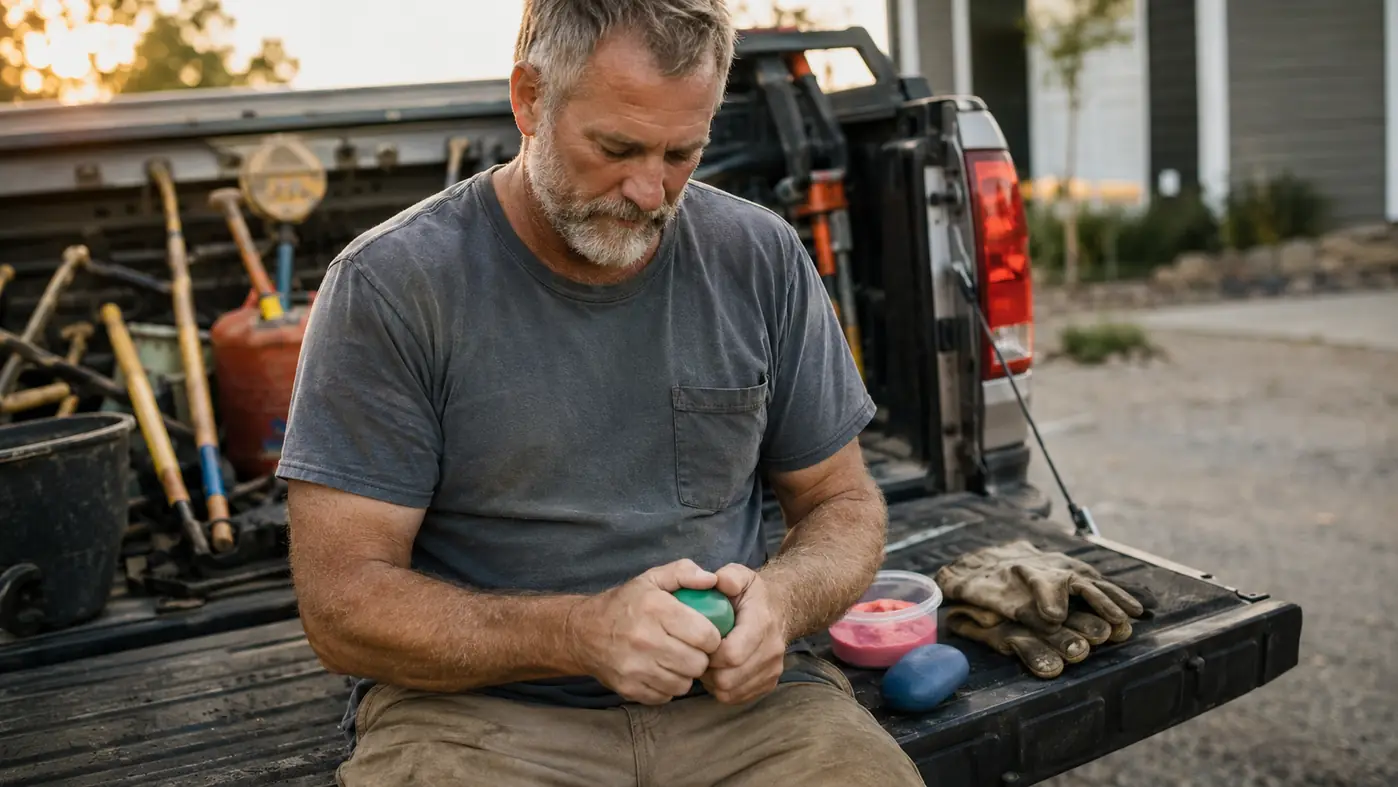
Somebody asked in the comments on my last write-up why I never mention the rubber hand exerciser my physical therapist Dana also gave me back in April, the oval-shaped thing marketed as the Thera-Band hand exerciser. Fair question. I ran both for six weeks side by side once my forearm strain was mobile enough to load, and the short answer is that FlintRehab's therapy putty won more often, but not by as much as I expected, and the Thera-Band exerciser genuinely beat it in a couple spots that matter if you spend your day out of a hot truck console the way I do.
The two tools aren't really doing the same job even though they get shelved next to each other online. FlintRehab's four tubs of colored putty ask you to reshape the material with your fingers, which is what lets it cover squeezing, pinching, and pushing your fingers open against resistance. The Thera-Band hand exerciser is a solid molded shape you squeeze shut and let spring back, one resistance built into one piece. If your hand problem is mostly about closing a fist harder, the exerciser is simpler and gets right to it. If it's about the whole range a hand actually uses on a job site, from a pinch grip on pruning shears to spreading your fingers wide after gripping a shovel all day, that's where FlintRehab's approach started pulling ahead for me.
To be fair to both, this wasn't a lab test. It's one landscaper running two products through the ordinary chaos of an actual workweek, truck cab, job sites, evenings on the couch, so treat everything below as a single, honest data point rather than the last word on either product.
| FlintRehab Therapy Putty | Thera-Band Hand Exerciser | |
|---|---|---|
| Resistance Levels Included | Four levels, x-soft to firm, in one 4-pack order | One resistance level per unit, sold as a single exerciser |
| Movement Patterns Trained | Squeeze, pinch, and finger extension all work with the same tub of putty | Mostly squeeze and flexion, extension work is awkward against a solid shape |
| Cold-Weather Readiness | Needs a minute of warming in the hands before it moves right on a cold morning | Ready to squeeze the second you pick it up, no warm-up step needed |
| Mess and Residue | Leaves a thin oily film on the hands after a session | Dry rubber, wipes clean, nothing left behind |
| Heat and Storage Tolerance | Tub lids can crack after months riding in a hot truck console | Solid rubber holds up fine in heat, nothing to crack or melt |
| Grip Variety For a Group | Four colors mean the whole crew can share one order at different strength levels | Each unit is one resistance, so sharing means passing around a single strength |
| Sense of Progression | Color-coded levels give a built-in feel of moving up as one tub stops being hard | One exerciser doesn't show progress on its own without buying a second, firmer unit |
Where FlintRehab Wins
The resistance progression is the biggest reason I kept reaching for FlintRehab over the exerciser once the first couple weeks passed. Four tubs, four levels, one order, and I moved through yellow to red to green over about nine weeks without buying anything else. The Thera-Band hand exerciser I had was a single medium resistance, and once that stopped feeling like real work around week three, my only options were to keep squeezing something that wasn't challenging me anymore or go buy a second, firmer exerciser separately. Nobody mentions that going in, and it's the kind of thing that only shows up once you've actually lived with a product for more than a week or two.
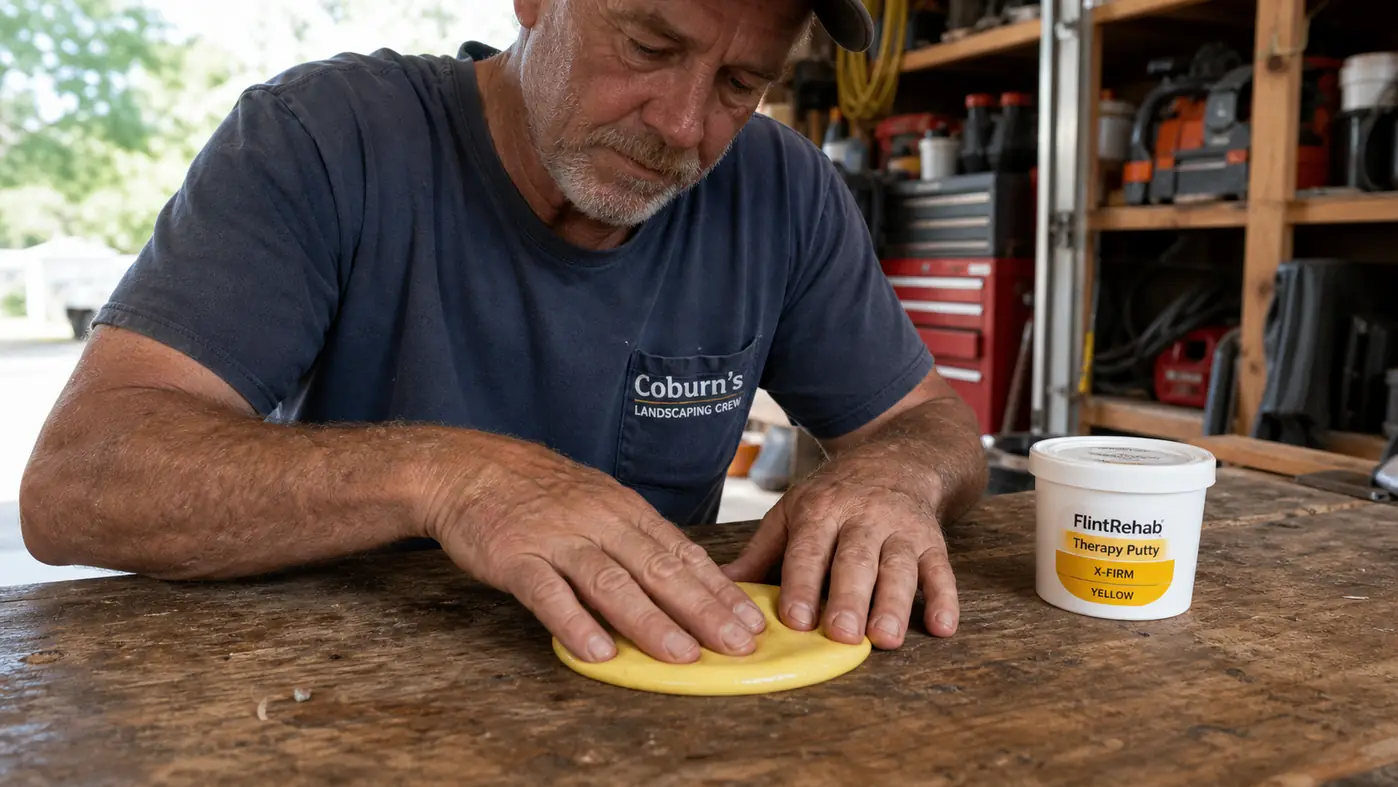
The other place FlintRehab pulled ahead was finger extension work, pushing my fingers open against resistance instead of just closing them. Dana was specific that a torn forearm muscle affects opening the hand almost as much as closing it, and putty lets you flatten it into a disc and push your fingers out against it. Try that with a solid oval exerciser and there's nothing left to push against once your hand opens, the shape just falls out of your palm. Odell noticed the same thing when he borrowed both from me for a week, since his early arthritis shows up as stiffness opening his hands first thing in the morning, not weakness closing them.
There's a durability angle to the four-tub setup too that I didn't appreciate until Odell started borrowing mine regularly. Because each tub is a different resistance, our crew ends up treating it almost like shared equipment, whoever needs the softer yellow for a stiff morning takes it, whoever's further along grabs green. Try sharing a single Thera-Band hand exerciser with a crew and everyone's fighting over the one resistance level whether it fits their hand that week or not. It's a small thing until you're the guy who bought the tool and everyone else on the truck wants a turn with FlintRehab's.
Where Thera-Band Wins
I won't pretend the exerciser lost everywhere. On a cold morning, the kind the valley throws at us from October through March, the Thera-Band hand exerciser was ready the second I picked it up. FlintRehab's putty, especially the firmer black tub, needs a minute of working it in your hands before it stops feeling stiff and brittle and actually behaves like putty again. If you're the type who wants to grab something in a truck cab at six in the morning and go straight to work with no warm-up step, that's a real point in the exerciser's favor, and I'd tell you that straight even though I'm the guy who keeps recommending FlintRehab.
The exerciser also wins on cleanliness and heat tolerance, two things that matter more than they sound like they should once a product lives in a truck console for months. FlintRehab's putty leaves a thin oily film on your hands that needs a paper towel or a quick rinse before you're shaking a client's hand at the end of a job. The Thera-Band exerciser is dry rubber, wipes clean, nothing left behind. And two of my four FlintRehab tubs have cracked lids after a Tennessee summer of truck heat, while the solid rubber exerciser hasn't so much as softened sitting in the same console.
There's also just less to think about with the exerciser. No color to remember, no worrying about whether the tub lid cracked in the glovebox, no wiping your hands before you answer the phone. If you want one simple tool that does one job and nothing beyond it, the Thera-Band hand exerciser doesn't ask anything of you beyond squeezing it, and some weeks that's exactly the kind of low-effort I have the patience for.
What I'd Tell You If You Only Have Room for One
If I could only keep one of these in the truck for the next year, it's FlintRehab, and it isn't close once you factor in the extension work and the fact that four resistance levels means I'm not going shopping again anytime soon. But I'd be lying if I said the exerciser never earned its spot back in my pocket on a cold, wet Tuesday when I didn't want to spend two minutes warming up a tub of putty before I could get anything out of it. Different tools solve different five minutes of your day, and that's really what this comparison came down to for me.

How I Tested Both, Side by Side
I ran both for six weeks starting in May, once my PT visits wound down and I was doing homework on my own. Yellow and red FlintRehab tubs lived in the truck console next to the Thera-Band exerciser Dana had handed me earlier in recovery. I'd genuinely reach for whichever one was closer, no forced rotation, because I wanted an honest read on what actually got used instead of what I intended to use when I first laid them both on the passenger seat.
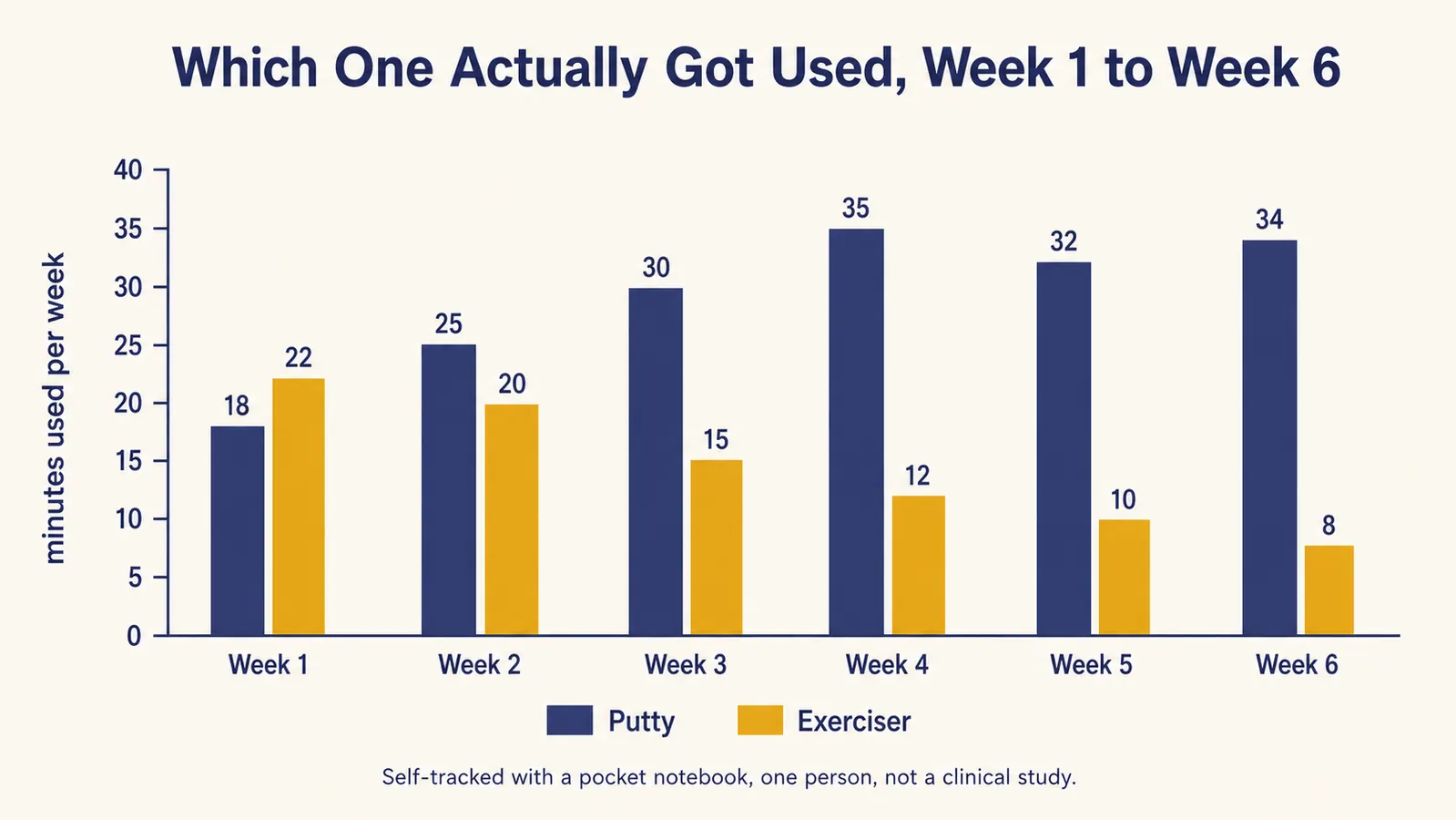
What I found, tracked on the same legal pad I use for everything else, is that I reached for the putty more and more as the weeks went on, and the exerciser less, mostly because the putty gave me something new to work toward once the old resistance stopped being any real effort. That's reflected in the chart below, and it's one guy's own numbers scribbled in a truck, not a lab test with a control group.
Some of that gap was pure timing. Weeks four through six landed right in the middle of a push to get three properties turned over before a stretch of rain, which meant twelve-hour days and less patience for anything complicated. The putty won those weeks because working a ball of it while I ate a sandwich in the truck cab took zero extra effort, while the exerciser required a level of attention, opening and closing at a steady pace, that I just didn't have left in me most evenings. That's not a knock on the exerciser, it's more that FlintRehab's putty fits into dead time in a way that's harder to notice you're even doing.
If your hand problem is more than just a weak squeeze, one resistance level isn't going to cover it for long.
FlintRehab's 4-pack covers squeezing, pinching, and finger extension in one order, so you're not stuck buying a second tool once the first one stops being hard. Check today's price and current availability on Amazon.
Amazon Check Today's Price on Amazon →Who Should Buy Which
If your hand or forearm problem covers more than one kind of movement, closing, opening, and pinching, or if you know you'll want to keep progressing over a few months without buying a second or third product later, FlintRehab's four-pack is the one I'd tell Odell to grab first, and I did. I wrote up the full story of what four months of it did for my own grip in my long-term FlintRehab therapy putty review, including the parts that took longer than I expected. If you want the unfiltered version, the stuff that annoyed me along the way, I laid that out separately in my honest FlintRehab review. The Thera-Band hand exerciser is a reasonable pick if you specifically want something that needs zero warm-up, stays completely dry, and you're only dealing with one kind of weakness, mostly a weak squeeze, since that's the single movement it handles well without any mess. For a step-by-step look at building forearm strength with putty specifically, I put together how to strengthen your forearms with therapy putty based on what worked for me and what didn't.
There's a middle case worth naming too. If you already own a single hand exerciser sitting in a drawer somewhere and you're only dealing with mild stiffness, you probably don't need to replace it. But if you've had an actual injury, a strain, a tendon issue, arthritis a doctor or physical therapist has flagged, or you just know your grip has quietly gotten weaker than it used to be, that's when the four-level range in FlintRehab's pack stops being a nice-to-have and starts being the thing that carries you from where you are now to where you want to be, one color at a time.
Six weeks of side-by-side testing, and the putty is still the one riding around in my truck.
FlintRehab's 4-pack gives you a full progression of resistance in one order, without restocking every few weeks or guessing what to buy next. See current pricing and stock on Amazon.
Amazon Check Today's Price on Amazon →